SGT Harold A. Spatz, Doolittle Raider, Engineer – Gunner – Plane 16, Seat of Honor, Row B Seat 4
By Janice A. Nielsen
Harold Althouse “Skinny” Spatz was born on 14 July 1921 in Lebo, Kansas. He was the son of Robert Althouse Spatz and Gladys Antrim Spatz. Harold had one older brother, Robert J. Spatz, and one younger sister, Reba Jean Barnett. His father took one look at Harold when he was born and said he is so skinny, and the nickname stuck.
Harold “Skinny” Spatz was a normal Lebo, Kansas kid back in the 1930’s. He grew up playing sports and did well in school.
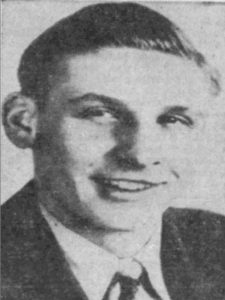
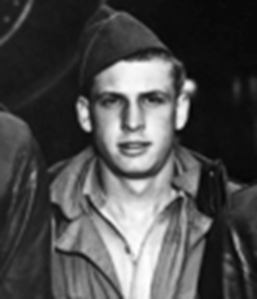
Harold Spatz (High School) Sargent Harold A. Spatz, AAF
His father, born in 1890, was a merchant in Lebo and a part owner of the Lebo Mercantile company. His mother, born in 1898 died in a tragic accident with the family’s car and a trolly car July 1927. Robert Jr., Reba and Harold were seriously injured but recovered. Their father Robert Spats Spatz suffered from internal injuries but survived. Robert died in 1969.
Harold graduated from Lebo High School in June 1939 and entered military service on November 25, 1939, at Fort Riley, Kansas. He wanted to make the military his career. He received training as aircraft mechanic at Glendale, California from September 1940 until March 1941. Where he trained for the Raider Mission. In order for the planes to be able to take off in the short distance on the carrier and to make the long distance to Japan, most of the interior of the aircraft was stripped to the bare bones to allow for additional fuel tanks.
Harold was assigned to plane 16 (Plane #40-226} which was the last to take off. Their targets in Nagoya, Japan were Matsushigeche Oil Storage, and the Atsuta Factory which produced aircraft, small arms, and tanks.
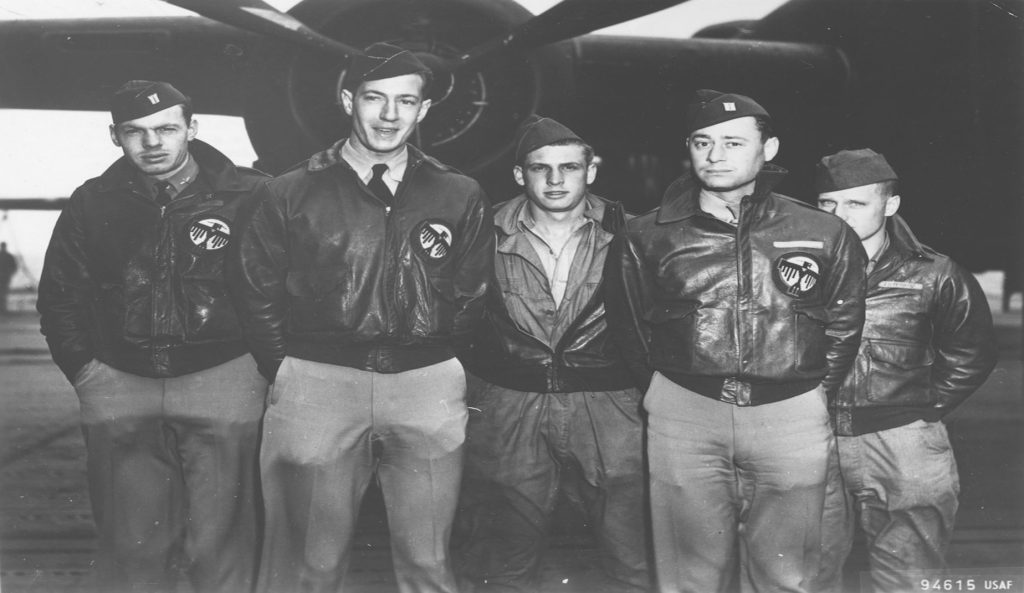
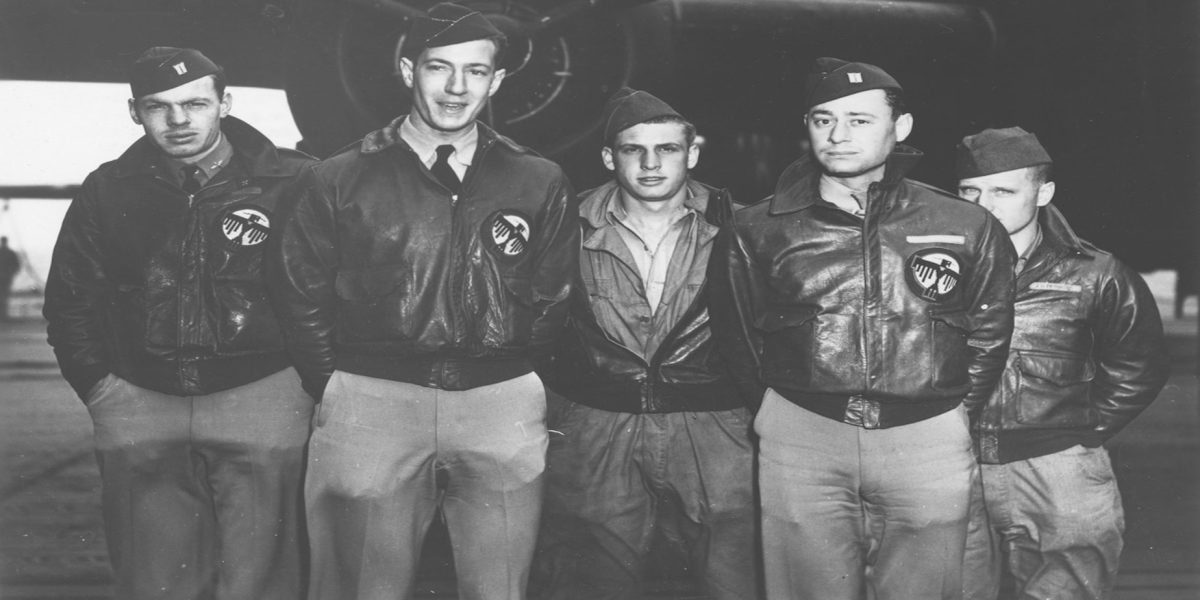
Crew No. 16: 34th Bombardment Squadron was Lt. George Barr, navigator; Lt. William G. Farrow, pilot; Sgt. Harold A. Spatz, engineer/gunner; Lt. Robert L. Hite, copilot; Cpl. Jacob DeShazer, bombardier. (US Air Force photo)
After completing their mission and running short of fuel, plane 16 was one of two that crashed in the waters off the Chinees coast. The crew was captured by the Japanese along with three crew from Plane 6. Two of the crew in plane 6 died from injuries sustained in the crash.
Initially the Japanese jailed the flyers, torturing them for information. Confined and poorly fed, the men contracted dysentery and beriberi. Later the men were sent to Tokyo, Japan for further interrogation, then returned to Shanghai, China where they were again imprisoned.
The Japanese determined they were not prisoners of war but war criminals. On October 14, 1942, the Japanese conducted a mock trial, and although never told of the charges against them, they were found guilty and sentenced to death. 2nd Lt. Dean E. Hallmark, 2nd Lt. William G. Farrow, and Sgt. Harold A. Spatz were selected for execution, while the others sentences were commuted to life in prison.
The three men were executed in Shanghai’s Public Cemetery No. 1, in accordance with Japanese military tradition: they were forced to their knees, blindfolded with their arms tied behind them, then shot simultaneously by three soldiers in the center of their foreheads.
Following their execution, their bodies were cremated, and boxes of their ashes were taken to the International Funeral Home in Shanghai where they remained until the end of the war.
The three Doolittle raiders who were executed were allowed to write a farewell note before their execution. Via the Red Cross, these farewell letters would be delivered to the American authorities, who in turn would deliver them to the families. However, the letters were never delivered to the Red Cross by the Japanese authorities. After the war, in 1946, they were found and only then were the letters delivered to their relatives.
Harold’s short letter to his father read
“I will say my last goodbye to you. My personal property consists of my clothes. If I have inherited anything since, I become of age, I will give it to you. I want you to know that I love you – and God bless you.”
The Japanese had also promised the three Doolittle raiders to deliver their ashes after the execution to the family in America via the Red Cross. Again. Japan did not keep this promise. The ashes were recovered after the war, but under a different name. Spatz’s urn was found under the name E.L. Brister. They had renamed the urns to confuse the Americans, but later clarified them correctly.
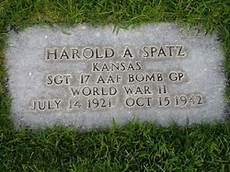
SGT Spatz”s ashes were brought to Hawaii in 1946 and interred at Schofield Barracks, Mausoleum #2, Oahu. He was later re-interred to the National Memorial Cemetery of the Pacific, Honolulu, Hawaii on 10 October 1949. (Punchbowl Cemetery) Grave Q297.
Sgt Harold A. Spat’s awards include, Purple Heart, Prisoner of War Medal, Distinguished Flying Cross, Aerial Gunner Badge and the Chinese Breast Order of Yung Hui.
Harold has not been forgotten.
In 1997, a memorial stone was gifted to Lebo, Kansas by Harold Spatz’s sister, Reba Jean Spatz Barnett, which was from her farm in Chase County, Kansas, and was prepared honoring six local service men. This memorial is standing in Lebo Memorial Garden at the center of town.
On May 20, 2000, the United States Air Force dedicated building 340 at McConnell Air Force Base to honor Harold A. Spatz.” Spatz Hall” at McConnell AFB in Wichita, Kansas
Colonel John F. Gaughan II, Vice Commander of the Department of the Air Force, said that Harold displayed unquestionable courage during the Doolittle Raid, and while held captive by the forces of Imperial Japan in 1942, deem it fitting to have his memory enshrined to inspire current and future Air Force members.
In 2003, Caroline Busboom Spatz (Harold’s sister -in- law) donated land to the town of Lebo, Kansas for the HAROLD A. “SKINNY” SPATZ MEMORIAL PARK. Today there is a pavilion that anyone can use, and an American flag in the park.
In 2018, The Lebo, Kansas American Legion Post was chartered as the Harold “Skinny” Spatz Post No. 323 Department of Kansas in honor of Sgt. Spatz, a Lebo native.
In 2024, Sgt Harold A. Spatz received a Seat of Honor Plaque in the theater of the Pearl Harbor Aviation Museum, Honolulu, HI. (Seat B-4)