
Nine thousand miles from Redlands, Iwo Jima is a tiny island, about ten miles square. As we approach it from the air it looks like a pork chop, and you can see smoke and steam, still escaping its volcanic black sands. The Japanese call the island Iwo To, which means ‘Sulphur Island’. As you step off your airplane, you still smell the sulphur. The island has increased in height, over 75 feet, since the end of the Battle of Iwo Jima, 80 years ago. The skinny part of the ‘pork chop’ bears the remains of an ancient volcano. It is an icon for the Marine Corps. Its name is Mount Suribachi.
The controversial decision to take the island was because of its strategic importance. It was within 900 miles of Japan, and important to the Japanese for the defense of their homeland. For the Americans, it could be used as a staging area for the invasion of Japan. And importantly, it had an airstrip that would be used for emergency landings by battle-damaged, Guam-based bombers, returning from raids over Japan. By the end of the war, over 2300 ten man bomber crews, or 23000 airmen, were saved.
About 23000 Japanese soldiers defended it and lived and fought in over 11 miles of underground tunnels and caves, where sometimes, the temperatures reached over 100 degrees. Rainwater was the only source of drinking water. For weeks before the battle began on February 26th 1945, the water ration was reduced to one cup a day The soldiers could only bathe in the ocean. Many died of dehydration before the battle was over… whose number is known but to God..
Before the American amphibious invasion, Navy and Army Air Corps planes bombed the little island daily. For over two months! Then the invasion fleet arrived and fired artillery and rockets for three solid days. Navy and Marine planners calculated they would be victorious… in 3-5 days.
They were wrong.
If you saw the Clint Eastwood movies Flags of our Fathers and Letters from Iwo, or even watched John Wayne in The Sands of Iwo Jima, you have an idea. In 36 days of bloody fighting the Marines for the first time in their history suffered more casualties than their enemy.The brilliant Japanese General Kuribayashi planned the defenses and anticipated where the Marines would land. His mortars and artillery had all been pre-aimed to hit every inch of the landing beaches. His soldiers would pop out of hundreds of cave openings, fire, and then hide again until the Marines had passed. At one point, there were 75,000 Marines on the island. Some Marines never saw a live Japanese. Because of their warrior Bushido code of honor, the enemy believed it was shameful to surrender, and often chose to commit suicide instead. The Marines had no choice but to use flamethrowers, dynamite, and even sea water, to close the caves to suffocate their relentless enemy. By March 26th, the last day of the battle….almost 30,000 Japanese and Marines had died in battle. (If you placed them all head to toe it would create a line 31 miles long! All the way to Cabazon!). All but two hundred of the 23,000 defenders were killed….7000 brave Marines lost their lives. The most prominent statement of the war was made by Fleet Admiral Chester Nimitz, who solemnly declared of the Marines, “Uncommon courage was a common virtue.” Of the 37 Medals of Honor given to Marines in WWII over half were earned on Iwo….
Of the original 250 Marines in a company who assaulted the island… in some companies only 12-18 remained who could walk to their landing craft to return to their ships. Casualty attrition rates were as high as 90% for some units!
The Marines who were killed were placed in temporary graves, and a Jewish Chaplain gave what has become one of the most beautiful memorial dedications ever prayed. You could..and you should…Google ‘Iwo Jima prayer’ to experience the full prayer for yourself. Rabbi Roland Gittelsohn stayed up all the night before, writing his Eulogy. (I have probably read it 100 times in the last 25 years since I discovered it, and almost every time I have choked up.) Here is just ONE paragraph:
“WE DEDICATE OURSELVES, first, to live together in peace, the way they fought and are buried in war. Here lie men who loved America because their ancestors, generations ago helped in her founding, and other men who loved her with equal passion because they themselves or their own fathers escaped from oppression to her blessed shores. Here lie officers and [privates], [Blacks] and whites, rich and poor…together. Here are Protestants, Catholics, and Jews…together. Here no man prefers another because of his faith or despises him because of his color. Here there are no quotas of how many from each group are admitted, or allowed. Among these men there is no discrimination. No prejudice. No hatred. Theirs is the highest and purest democracy.”
For the past 40 years there has been the most remarkable gathering of former enemies, who fought savagely on the battlefield 80 years ago…and now come together as friends and allies….to honor the courage and valor of their fallen warriors. The Reunion of Honor only takes place on Iwo Jima. Since Iwo was returned to the Japanese, this solemn ceremony is the only time that Americans are allowed back on its soil….just this once a year. It is hallowed ground, especially for the Japanese, who treat it with the respect and dignity that we Americans do, for our Arlington National Cemetery. As an example, all male tourists are required to wear a coat and tie while on the island.
At the end of the War in the Pacific, the Marine dead were returned to the states. Today, there are still several thousand bodies of unrecovered Japanese soldiers, lying beneath the black sands of Iwo Jima, in collapsed caves and tunnels.
The hour and half Reunion of Honor ceremony includes much pageantry, music, speeches, prayers and the laying of wreaths. This year, six veterans, ages 99 and 100, family members, senior military officers, a delegate from the American Embassy in Tokyo, the Commandant of the Marine Corps, and our Secretary of Defense Pete Hegseth, were among the 134 Americans in attendance on one side of a Japanese memorial. Opposite were 100 Japanese officials who had flown in from Tokyo, including their Prime Minister, Minister of Defense, and members of their Diet or Assembly. A special guest was the grandson of General Kuribayashi, the defense genius of Iwo, whose body was never recovered, in the collapsed tunnels below. Several Japanese speakers walked to the American side, and bowed together, in a sign of respect and courtesy. Then, before his speech, the Four Star Marine Commandant bowed his head in prayer for a moment in front of the memorial, gave the sign of the cross, then stood at attention, turned to the Japanese delegation, and snapped a salute. Pete Hegseth walked to the podium for his speech, put his hand over his heart as he bowed in a brief moment of respect at the memorial, and then to the Japanese delegation. Six members of the delegation then came forward to pour water from a wooden bucket and wooden ladle over the base of their memorial, symbolizing the water that was denied their brave soldiers.
When the ceremony concluded, with stirring marching music, I was particularly struck by the sight of the Marine and Japanese honor guards, side by side, marching with the Stars and Stripes and the Japanese ‘meatball’, blowing in the sunny breeze. (A grain of black sand must have blown into my eye….!)
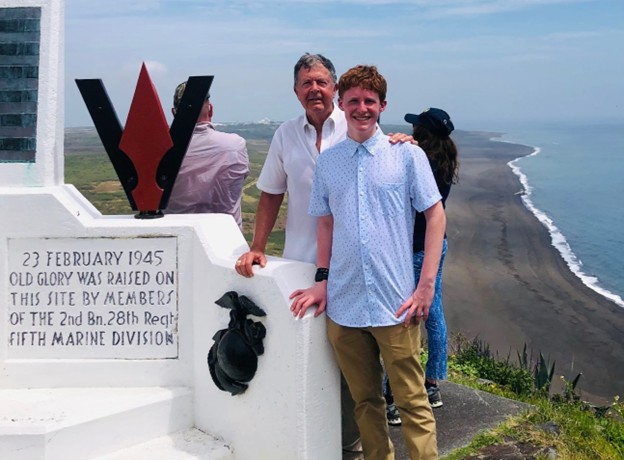
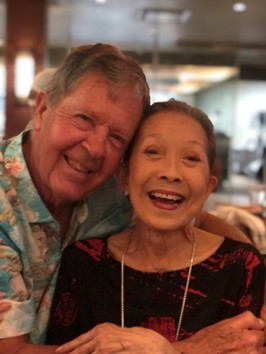
I attended the ceremony once, 9 years ago…and I returned just two months ago for the 80th Anniversary of the Battle of Iwo Jima and the Reunion of Honor. I was accompanied by a former Stanford midshipman of mine, now a retired Navy Captain, my 16 year old grandson, and a fellow Redlander, Jim Nolin, whose parents served as Marines in World War 2. Jim’s late wife, Jo, an “Army Brat,” was born in Japan during the post war occupation. (Our visit also enabled Jim to spend a private moment, saying a final farewell to his wife.. in her homeland.. as she had requested, since the island is now Japanese territory.)
My grandson Nathaniel and I hiked the 13 mile round trip to the top of Mt Suribachi, the site of the iconic Joe Rosenthal photo of the five Marines and one Navy Corpsman, raising the American flag. (Not many of you would know that within two weeks of that photo, three of those brave men were killed in combat…such was the savagery of the fighting, on that tiny island.)
We hiked the first 3 miles from the airport, in our coats and ties in the oppressive 85 degree heat and 70% humidity, until we passed the ceremony site. As we removed them once we were out of sight of the dignitaries, we chatted about what softies we are today….imagining what it must have been like eighty years ago…wearing a three pound steel helmet, long sleeve pants and shirt, still wet from the surf, carrying two one quart canteens, a weapon, ammo and a pack….65-80 pounds of gear in the same unrelenting heat. And no shade…anywhere.
At Suribachi’s summit today there is no American flag… but I wanted my grandson to look down on the landing beaches, to have the same view that the enemy had…and realize why the exposed Marines suffered so terribly. After we returned home I asked him to write what impacted him about his time on the island. This is what the 16 year old texted back to me:
“What I took away from this trip, Grandpa, is that it is important to understand our history and the importance of having peace through power. And how it is also important to honor the veterans that fought in the war, so that we can enjoy the freedoms we have today.”
I think Nathaniel stuck it!
I’d like to briefly mention three of the veterans I met, and tell the kinds of stories you don’t see in the movies or read in the history books:
Gene Bell was 93 when I met him on Iwo, and I was happy to learn that he lived in nearby Beaumont, California. I took him to a University of Redlands classroom where he held the 40 students spellbound, relating his experience as a 17 year old on Iwo. Since the legal age to join the Marines was 18, he was asked by a snarky 20 year old, “WHY would you LIE about your age??” He startled and stunned the students and you could have heard a pin drop when he simply exclaimed, “Because I LOVE AMERICA!”
Jack Lazard was a 19 year old SeaBee (or ‘Construction Battalion’: the guys who built roads and airports, following the Marines ashore) Jack served as a bulldozer driver. The landing beaches quickly became so clogged from destroyed equipment and vehicles stuck in the soft volcanic sand (like walking in coffee grounds, one veteran said) that the incoming landing waves were turned back. Jack’s unit was tasked with clearing the debris. The first bulldozer driver was killed by a sniper. A backup driver jumped in the seat after clearing the body away…and was immediately shot in the head. The unit commander then asked for volunteers to be the third driver … .and…Jack volunteered. How do we describe such courage? Do we even make such men today?
Warren Kohler was in the first wave and wounded on day 13 when a bullet hit him in the foot and he somersaulted into the sand, jamming his weapon. He spent the night behind a sand dune, shivering, and was taken the next morning by litter to the beach, where he waited to be returned to the hospital ship. An incoming Marine from a landing craft offered him a drink from his canteen, which Warren gratefully accepted. As the good Samaritan stood up to secure his canteen to his belt, he was instantly cut in two by a Japanese machine gun burst. From his litter, Warren could reach out and touch the dead Marine’s leg, he was so close.
As General George Patton said: “It is foolish and wrong to mourn the men who died. Rather we should thank God that such men lived.“
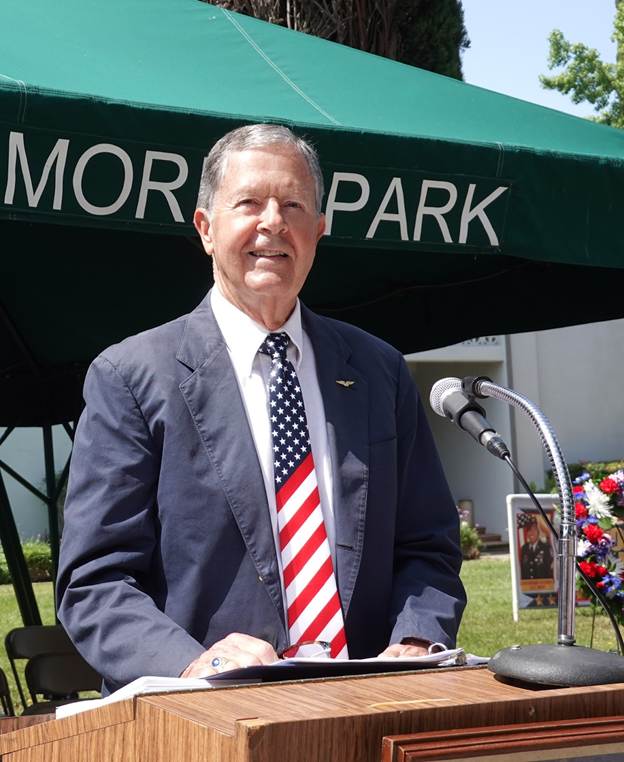
In conclusion, Secretary Hegseth finished his remarks at the podium with a benediction that is very appropriate for us today at Hillside Cemetery, surrounded as we are, by the headstones of many Redlands warriors. He said:
“We are fortunate to stand here together, shoulder to shoulder, as friends and as Allies, living their legacy of honor. May almighty God bless us. And may almighty God, and the grace and mercies of our savior Jesus Christ, always surround our American warriors.
Thank you and God bless!”
—
David O Maupin, CFP®
Maupin Payne Financial Advisors
310 East Citrus Avenue
Redlands, CA 92373
909-798-1712